
Why it matters
The producer
Poderi Fiorini is a family estate founded in 1919 in Savignano sul Panaro, in the province of Modena. Its wines are anchored in Lambrusco di Sorbara, the most aromatic and lightest of the Lambrusco denominations, grown on the sandy, river-influenced flatlands north of the city. The estate also produces wines under the Torre dei Nanni label from a hillside holding that straddles the Modena and Bologna production zones, extending the range into sparkling Pignoletto and still reds from the Colli Bolognesi.
Farming is certified organic under ICEA from the 2019 harvest, covering both vineyard and cellar. All vines are hand-worked and fruit is harvested by hand. The cellar uses gravity from the crusher to move must directly into autoclaves, avoiding machinery contact at a stage when oxidation and bruising risk are highest. Sulfur dioxide use has been deliberately reduced across the range.
Place and vineyards
Where the wines begin
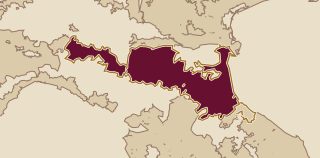
Lambrusco di Sorbara is a denomination carved from the Modena plain north of the city, along the corridor between the Secchia and Panaro rivers. The soils here are sandy and clayey, deposited over centuries by river sediment, and they drain freely in ways that the heavier clay south of Modena does not. That drainage shapes the grape: Sorbara grown on these lighter soils tends toward high natural acidity, pale ruby colour, and pronounced aromatic lift rather than the darker pigment and firmer tannin of Lambrusco Grasparossa di Castelvetro, the denomination anchored in heavier clay further south.
Torre dei Nanni, the hill holding joining the Modena and Bologna production areas, carries mainly clayey, silt-rich soils. Where Sozzigalli's sandy ground favours delicacy, Torre dei Nanni's heavier soil supports the ageing of still wines made from Barbera and Cabernet Sauvignon.
In the cellar
Vineyards and cellar
Hand harvesting across all three holdings means fruit arrives at the cellar in better condition than mechanically harvested grapes: berry integrity is higher, oxidation starts later, and sorting decisions happen at the vine rather than on a conveyor. For a sparkling wine built around aromatic delicacy, harvest method has direct consequences in the glass.
After crushing, must moves by gravity into autoclaves without further machinery contact. In autoclave fermentation, which is the standard method for Lambrusco production, the secondary fermentation that creates the sparkle happens under pressure in sealed tanks rather than in bottle. The advantage over tank-to-bottle transfer is minimal handling; the advantage over traditional method is speed and the preservation of fresh fruit character over biscuit and yeast complexity.
Wines to know
The range in view
The range divides along geographic and stylistic lines.
Corte degli Attimi is the signature Lambrusco di Sorbara DOC: a lightly sparkling red with vivid violet colour, very fine perlage, and strawberry-forward fruit from Sozzigalli and Ganaceto parcels on sandy, river-influenced soils. Secondary fermentation runs in autoclave. The wine is light-bodied with high natural acidity, a characteristic of the Sorbara denomination that separates it from the broader Lambrusco family.
A useful way in
A bottle to begin with
Corte degli Attimi Lambrusco di Sorbara DOC is the right first bottle. It comes from Sozzigalli and Ganaceto on the Modena plain, made from varietal Lambrusco di Sorbara grown in sandy, river-influenced soils near the Secchia River. The wine is lightly sparkling, violet in colour, with fine persistent bubbles, strawberry and violet aromatics, and a palate driven by high acidity rather than body or tannin. There is no oak. The wine finishes clean and short, which makes it work well with food: the classic Emilian pairing is with cured meats, Parmigiano-Reggiano, or the fatty, rich pasta dishes of the Modena plain.