
Why it matters
The producer
San Patrignano began not as a winery but as a place to come when there was nowhere else to go. Vincenzo Muccioli founded the community in 1978 on the hills above Rimini, and wine grew out of that founding purpose. The early production was as simple as it could be: Sangiovese and Trebbiano, a single press, five wooden barrels. What exists today is 110 hectares of vines, 500,000 bottles a year, a named winemaker in Luca D'Attoma, and a Romagna Sangiovese DOC riserva made from organically farmed parcels.
The community dimension is not a marketing layer placed over the wine. Residents tend the vines, work the harvest, and run the bottling line. Wine sales fund the community's operations. The two things are the same operation, and they have been since the beginning.
Place and vineyards
Where the wines begin
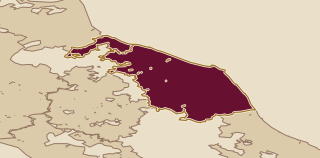
The vineyards sit on the hills overlooking Rimini at an average elevation of 200 metres, a few kilometres from the Adriatic Sea and within sight of Mount Titano in the Republic of San Marino. That coastal position shapes what grows here and how it ripens. Salty sea breezes move through the hills through summer, moderating daytime heat and reducing the conditions under which fungal disease develops. The producer attributes a mineral character in the wines directly to that salt in the air.
Romagna Sangiovese DOC is the appellation for the estate's principal red wine, AVI. The classification covers Sangiovese grown on the hills between the Po Valley and the Adriatic watershed, where the Adriatic influence produces a warmer, slightly softer growing season than the Sangiovese zones further west in Tuscany. The label consequence is a Sangiovese that carries dark cherry and earthy spice with a tannic frame built for medium-term ageing rather than the leaner, higher-acid profile of Chianti Classico.
In the cellar
Vineyards and cellar
Fifty hectares of Sangiovese are farmed organically and managed by community residents. The organic approach in the vineyard keeps synthetic treatments out of parcels where the estate's most significant wine, AVI, originates. Vine density at 6,600 per hectare means each plant carries a smaller crop load, concentrating flavour and tannin in the fruit.
In the cellar, grapes are destemmed, gently crushed, and fermented in stainless-steel vats. Ageing vessels vary by wine. AVI spends time in large traditional barrels and smaller casks before bottle rest, a combination that softens tannin without imposing heavy oak character. Montepirolo is aged in barriques and tonneaux, which adds spice and roundness to the international-variety blend. Aulente Rosso uses stainless steel and light barrel contact, keeping the wine fresh and ready to drink young.
Wines to know
The range in view
The range is built around three reds. Each occupies a different register and draws on different grapes and cellar routes.
Aulente Rosso blends Sangiovese with Merlot, Cabernet Sauvignon and Cabernet Franc. It is aged in a mix of stainless steel and barrel, giving red cherry fruit, soft tannin, and an easy, round texture suited to drinking without cellaring. It is the most approachable bottle in the range and the lowest point of entry into the estate.
A useful way in
A bottle to begin with
Start with AVI. It is a Romagna Sangiovese DOC Superiore Riserva: pure Sangiovese from 50 organically farmed hectares, fermented in stainless steel, aged in large traditional barrels and smaller casks, then rested in bottle before release. Dark cherry and earthy spice on the nose, firm and dry tannins that fill the mid-palate, a long finish with a characteristic bitter herb note. No heavy oak, no international-variety softness. AVI is the bottle where the estate's site, its grape, its farming and its cellar method all converge in one glass.