
Why it matters
The producer
Schlossgut Diel is a family winery in Burg Layen-Rümmelsheim, in Germany’s Nahe region, where the Diels have worked since acquiring the estate from Baron Dalberg in 1802. Caroline Diel is the cellarmaster and has led the estate with Sylvain since 2019. The setting includes historic Layen Castle, which dates to the end of the 13th century, but the working thread is dry Riesling: a range that begins with Nahesteiner and climbs through Eierfels to named Grosse Lage wines from Goldloch, Burgberg and Burg Layer Hölle.
That structure makes the labels useful. Nahesteiner is the estate-level dry Riesling, while Eierfels brings fruit from the top sites into a second wine. Goldloch, Burgberg and Burg Layer Hölle narrow the focus to named vineyards. The consequence is a cellar door argument in bottles: the grape remains Riesling, while the wine changes as the label moves from regional breadth to a particular site.
Place and vineyards
Where the wines begin
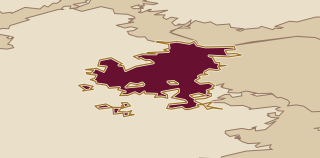
Burg Layen-Rümmelsheim sits in the Nahe, and Schlossgut Diel uses the region’s name on Nahesteiner before moving to individual vineyard names on its higher dry Rieslings. The place therefore appears in stages on the label. A bottle of Nahesteiner introduces the estate’s dry Riesling shape, while Goldloch GG or Burgberg GG asks for attention to a single named vineyard rather than a general regional blend.
The estate’s Grosse Lage vineyards are planted exclusively to Riesling. That concentration matters because the upper range is not a comparison between varieties: it is an examination of one grape across different vineyard names and wine levels. Riesling’s acidity and dry finish give those distinctions a firm frame, from the tart fruit and salt of Nahesteiner to the longer development expected from Goldloch GG.
In the cellar
Vineyards and cellar
Caroline Diel’s cellar work joins wooden piece barrels with temperature control, while Nahesteiner 2023 was raised in stainless steel and Stückfass. The two-vessel approach is reflected in a wine whose fruit stays measured rather than broad: yellow fruit appears first, then tart fruit, lively acidity and a dry finish with salt and earth.
The estate’s vineyard hierarchy also shapes how fruit is assigned to bottles. Eierfels is identified as the second wine of the Grosse Lage sites, while the Grosse Lage vineyards themselves are planted entirely to Riesling. The consequence is a clear progression in dry wine: an estate wine can show the house’s acidity and texture, while the named Grosse Lage bottles can carry a more concentrated vineyard claim.
Wines to know
The range in view
Nahesteiner is the VDP Gutswein and the opening dry Riesling. In 2023 it combines yellow-fruit aroma with tart fruit, brisk acidity, grip, salt and earth. Its stainless-steel and Stückfass élevage keeps the palate lean and dry rather than creamy or overtly oaky.
Eierfels takes the next position as the second wine of the Grosse Lage sites. Above it, Goldloch GG and Burgberg GG are separate vineyard wines, with Burg Layer Hölle completing the named dry Riesling sequence. Goldloch GG 2022 can be enjoyed now, though its fuller range of flavours may emerge after another five to ten years. Burgberg’s documented 2020 material includes lees ageing and a more structured profile, giving it a different frame from Goldloch rather than a duplicate role.
A useful way in
A bottle to begin with
Choose Schlossgut Diel Nahesteiner Riesling 2023 first. It is the estate’s VDP Gutswein, raised in stainless steel and Stückfass, and it makes the Diel approach tangible without requiring a long wait in the cellar. Expect restrained yellow fruit, lean tart fruit, lively acidity, grip, salt and an earthy edge in a dry finish.