
Why it matters
The producer
Fondo San Giuseppe sits on a north-facing plateau in the Romagna Apennines, 400 metres above Brisighella, surrounded on three sides by eleven hectares of woodland. Mariagrazia Rizzati and Stefano Bariani own and run the estate. Its five hectares of vines produce one well-documented wine: Fiorile, a dry white from Albana under the Romagna Albana DOCG, Italy's first DOCG awarded to a dry white wine.
Bariani worked for ten years in other wineries and wanted to express his own vision. He chose a plateau that most producers would have overlooked, drawn by a landscape that had not been tidied into agricultural ordinariness. The farming is certified organic through Suolo e Salute, and Bariani aligns with the natural-wine movement in his approach to the cellar: the aim is to do less, not more.
Place and vineyards
Where the wines begin
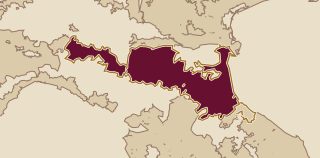
Brisighella is a small hill town in the province of Ravenna, in the Valpiana sub-area of the Romagna Apennines. The estate's plateau faces north, an orientation that prolongs the growing season and delays harvest compared to south-facing Romagna slopes. At 400 metres, the elevation brings a marked temperature swing between day and night. The estate links those cooler nights directly to the retention of floral and fruity aromas in the finished wine: the grape's aromatic charge is locked in before daytime warmth dissipates it.
The Lamone River runs close enough that in some vintages its valley humidity encourages Botrytis cinerea on sensitive varieties, including Albana. When noble rot develops, it can leave hydrocarbon and flint notes in the wine.
In the cellar
Vineyards and cellar
Fiorile comes from a single one-hectare vineyard planted more than forty years ago. Old vines on clay-limestone soil produce lower yields with more concentrated fruit and deeper extraction of the mineral character held in the marl layer beneath.
In the cellar, Bariani works without selected yeast and without skin maceration. Fiorile is fermented in stainless steel. After fermentation, half the wine goes into Allier tonneaux and half stays in steel for six months of maturation. The two halves are then blended and the wine spends a short final period back in steel before bottling. The Allier wood adds a faint texture and breadth without pushing the wine toward obvious oak flavour; the steel portion keeps the floral and citrus aromas direct and clean.
Wines to know
The range in view
Fiorile is the estate's principal wine and the only one with full source documentation. It is a dry white Romagna Albana DOCG Secco, made from the single old-vine hectare described above. The split maturation in steel and Allier tonneaux gives the wine two layers: the floral and fruit-forward quality from the steel-kept portion, and a slightly broader, more textured mid-palate from the wood. The tannin in Albana is real and present in Fiorile, integrated into the wine's density rather than sitting on the surface. Acidity is firm and salt is a consistent character across documented vintages.
The estate also makes wines from Trebbiano, Riesling Renano, Sangiovese, Chardonnay, Albana, Nera and Centesimino, plus a blend of Chardonnay, Trebbiano and Marsanne.
A useful way in
A bottle to begin with
Fiorile is the first bottle. It is a dry white from Albana grown on a single hectare of forty-year-old vines on clay-limestone soil at 400 metres, fermented in stainless steel and matured for six months across steel and Allier oak before blending. The glass brings yellow flowers and candied citrus on the nose, a broad and salty palate, firm acidity, and a tannic texture with grip and without roughness.