
Why it matters
The producer
Umberto Cesari is a family estate in Emilia-Romagna that came not from a winemaking dynasty but from a restaurateur's reading of the region. Umberto founded the estate in 1964, and what took root across the following decades was a large-scale operation with a specific agricultural conviction: that Emilia-Romagna's native varieties, Sangiovese for red and rosé wine, Pignoletto for white, deserved serious attention at volume.
Gianmaria Cesari, Umberto's son, leads the estate today. The operation covers 355 hectares across eight holdings, produces over 3.5 million bottles each year, and is supported by a permanent team of agronomists and oenologists working alongside the University of Bologna's Faculty of Agriculture. That academic collaboration is unusual for a commercial estate of this size and shapes how the vineyards are managed season to season.
Place and vineyards
Where the wines begin
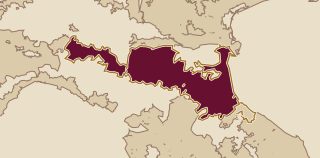
Emilia-Romagna runs east from the Po valley toward the Adriatic, a broad agricultural corridor that most outsiders associate with Parmigiano, Lambrusco, and the cooking of Bologna rather than table wine with regional ambition. The province of Forlì-Cesena, in the southern half of the region, is where Sangiovese dominates both red and rosé production. Costa di Rose carries the Rubicone IGT classification, a large coastal-facing zone in this province where the grape ripens with firm cherry character and enough acidity to carry a pale rosé style without heaviness.
Farther inland, on the lower Apennine slopes, Pignoletto grows in the hill zones west and south of Bologna. One of Emilia-Romagna's oldest indigenous white varieties, it produces wines with light effervescence, almond-edged aromatics, and citrus freshness. Colle Belvedere draws from these cooler hillside parcels and is vinified as a frizzante, a lightly sparkling style that suits the grape's natural aromatic delicacy.
In the cellar
Vineyards and cellar
Vineyard management across the eight estates follows SQNPI integrated-agriculture protocols, with agronomists monitoring each holding and research input from the University of Bologna influencing decisions on canopy management, yield control, and harvest timing. The framework limits intervention while maintaining consistent fruit across a large, geographically spread operation.
In the cellar, the two signature wines reflect different approaches to native-variety handling. Costa di Rose Sangiovese Rosé is made by direct pressing with a soft press, followed by rigorous static decanting to clarify the juice before fermentation at low temperature. The method minimises skin contact and phenolic extraction, yielding a pale colour, delicate aromatics, and a clean fruit line.
Wines to know
The range in view
The Umberto Cesari range spans both native and international varieties across several price points, but the two bottles that most clearly express the estate are Sangiovese-based and Pignoletto-based.
Costa di Rose Sangiovese Rubicone IGT is 100% Sangiovese, vinified as a rosé. The soft-press and static-decanting method produces a pale wine with rose-petal aromatics, fresh cherry fruit, and the kind of clean, food-friendly acidity that Sangiovese delivers when handled with minimal extraction. It is light in colour and direct in flavour, without the tannin or body of a red wine.
A useful way in
A bottle to begin with
Costa di Rose Sangiovese Rubicone IGT is the right first bottle. It is 100% Sangiovese made as a pale rosé, soft-pressed and cold-fermented to give delicate rose and cherry aromatics with a clean acid line and no oak. The colour is pale blush, the mouthfeel is light and dry, and the finish leaves Sangiovese's characteristic grip without any heaviness. It demonstrates what the estate does well: a native grape handled with technical care at commercial scale, producing something that is genuinely food-compatible rather than confected.