
Why it matters
The producer
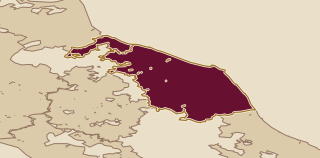
Valle delle Lepri farms a hillside in the Colli di Rimini DOC, in the southern edge of Emilia-Romagna south of Rimini, growing Sangiovese and Cabernet Sauvignon on 10 hectares of organic vines. The estate is built around a commitment that pre-dates most contemporary natural wine conversation: organic certification since 1992, spontaneous fermentation, no fining, no filtration, modest sulphite additions. The range comprises three red wines with a saline mineral thread through dark fruit and spice.
Grandson Luca Cecchini works as enologist. He removed commercial yeasts entirely around 2019, extending a low-intervention approach that his father Silvano had begun three decades earlier.
Place and vineyards
Where the wines begin
The Colli di Rimini DOC sits at the Adriatic edge of the Apennine foothills, a distinct zone from the Romagna Sangiovese DOC heartland that runs further north and west through Forlì and Faenza. The hills here face east toward the sea, with clay-rich soils on the slopes and cooling maritime air off the Adriatic moderating the warmth of the Emilian summer. For Sangiovese, grown here well inland from the coast on hillside ground rather than the flatlands of the Po Valley, this translates into riper fruit than northern Romagna but with the acid line and saline mineral quality that distinguishes the Rimini hills from the plain.
Cabernet Sauvignon is also authorised in the Colli di Rimini DOC. On this hillside it produces a wine that adds bell pepper, sage, and earthy notes to concentrated dark fruit, a profile more Bordeaux-adjacent than the warm, jammy Cabernet of many Italian DOC zones.
In the cellar
Vineyards and cellar
All three wines begin with spontaneous fermentation in stainless steel. After that, the cellar routes diverge by maceration length and vessel.
Fidelio, the entry Sangiovese, macerates 15 to 20 days on skins. It then spends six months in 500-litre French oak barrels and six more months in vitrified cement before bottling. The oak contact at this size adds texture without imposing vanilla or toast on the fruit; the cement finishing period preserves freshness and the saline mineral quality of the grape.
Wines to know
The range in view
The range is three red wines arranged by grape, maceration intensity, and cellar route.
Fidelio is the estate's Sangiovese in its accessible form: 15 to 20 days of maceration, half a year in 500-litre French oak, half a year in vitrified cement. It opens with cherry and plum, then moves into graphite, moss, and tea on the nose. The palate is led by acidity, with cherry and liquorice on a long finish and tannins that have evolved to introduce rather than block the fruit.
A useful way in
A bottle to begin with
Fidelio is the first bottle. It is Sangiovese from this hillside in its most legible form: spontaneous fermentation, 15 to 20 days of skin contact, six months in 500-litre French oak, six months in vitrified cement, then bottled without fining or filtration. On the nose it gives cherry and plum with graphite and moss underneath. The palate is acidity-led, with the cherry continuing through to a finish that picks up liquorice, and tannins that are evolved and fine rather than grippy.