
Why it matters
The producer
Weingut Schömehl GbR is the legal name of the Dorsheim family winery owned by Hartmut Hahn and Elke Schömehl-Hahn. The estate has operated as a winery since 1957, and its current work is divided clearly: Hartmut takes the vines and cellar, while Elke handles the commercial side that carries those bottles into sale.
Both Hartmut and Elke studied viticulture in Geisenheim. That shared training sits behind a practical division of labour: vineyard decisions and cellar handling remain connected at the estate, while the range and its presentation are managed alongside them rather than as an afterthought.
Place and vineyards
Where the wines begin
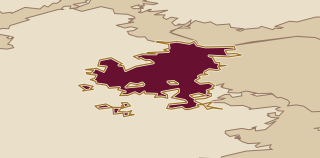
Schömehl is based in Dorsheim, in Germany’s Nahe region. Its current 15-hectare holding and 15 reported grape varieties give the estate room for more than one wine type: still wines sit alongside bottle-fermented sparkling wines, while Riesling provides a firmly documented dry bottling.
On a Schömehl label, the grape and style words matter. The 2024 Schömehl Riesling trocken is Riesling; trocken signals a dry wine. The earlier 2018 Riesling QbA trocken was also entirely Riesling, linking two documented vintages through grape and dry style rather than through an assumed house recipe.
In the cellar
Vineyards and cellar
Hartmut Hahn’s responsibility runs from vineyard to cellar, so the estate’s grape growing and vinification sit under one named lead. The documented environmental focus on steep slopes concerns the fruit before it reaches the cellar; the dry Riesling label then shows how that fruit is presented in a finished still wine.
Schömehl has also made its own bottle-fermented sparkling wines for more than 20 years. Bottle fermentation means the second fermentation occurs in the bottle, producing mousse rather than the still texture of dry Riesling. That method gives the range a distinct sparkling branch instead of merely a different label on a still wine.
Wines to know
The range in view
The range has three useful anchors: still wines across 15 reported varieties, dry Riesling bottlings, and bottle-fermented sparkling wines. Riesling is the grape with the clearest supplied bottle record: the 2024 Riesling trocken is dry and made from Riesling, while the 2018 Riesling QbA trocken was entirely Riesling. In both cases, acidity, fruit and a dry finish are the structural questions to bring to the glass rather than sweetness.
The sparkling wines perform a separate task. Their bottle fermentation brings mousse and a different texture, while the still Rieslings place dry structure at the centre. Independent profile material also records ice wine and spirits among the estate’s offerings, though the supplied record does not establish their current release details.
A useful way in
A bottle to begin with
Start with Schömehl Riesling trocken 2024. It is a current, clearly documented Riesling in a dry style, so the label gives a direct connection between grape, wine type and estate range. Pour it as a still wine and look for acidity, fruit texture and a dry finish rather than sweetness; those elements make it a useful first encounter before moving to the estate’s bottle-fermented wines.