
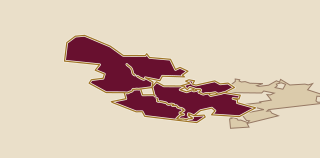
Sauternes and Barsac sit south of Bordeaux near the meeting of the Ciron and Garonne. Morning mist raises humidity around the vines, while afternoon sun dries them. In the right conditions, botrytis shrivels the grapes and concentrates sugar, flavour and acidity. Sémillon is the central grape, usually joined by Sauvignon Blanc and sometimes Muscadelle.
Noble rot makes harvest a selection
Botrytis does not affect every bunch or berry at once. Pickers return through the vineyard in successive passes, taking grapes as they reach the desired condition. The small volume of concentrated juice helps explain the intensity and cost of the wines. Sweetness is only half the structure; acidity keeps the finished bottle from feeling heavy.
Five names for the sweet-wine south
Sauternes and Barsac are the best-known names. Cadillac, Loupiac and Sainte-Croix-du-Mont sit across the Garonne and extend the sweet-wine map. Château d'Yquem occupies its own premier cru supérieur category in the 1855 classification, while Climens, Suduiraut, Guiraud and Rieussec offer other routes into the two principal appellations.
A useful way in
A younger bottle shows the balance
Begin with a younger Sauternes or Barsac and look for the pull between concentration and freshness. The label may emphasise sweetness, but the useful detail is the acidity beneath it. Once that balance is clear, the neighbouring appellations become easier to place as variations on the same mist, grape and patient harvest.
Elsewhere in Bordeaux
Continue through the region
- Bourg & Blaye22 producersBourg & Blaye is Bordeaux's Right Bank estuary country, centred on Merlot-led reds from Côtes de Bourg and Blaye Côtes de Bordeaux.
- Entre-Deux-Mers11 producersBetween the Garonne and Dordogne, Entre-Deux-Mers is known mainly for crisp dry whites and broadly priced Bordeaux wines.
- Graves & Pessac-Léognan20 producersSouth of Bordeaux, Graves and Pessac-Léognan place structured reds and ageworthy dry whites on the same gravel ground.
- Libournais36 producersEast of the Dordogne, Libournais brings together Saint-Émilion, Pomerol and Fronsac. Merlot and Cabernet Franc lead on clay, limestone, gravel and sand.
- Médoc59 producersMédoc is Bordeaux's Cabernet-led Left Bank peninsula, a gravel corridor containing Margaux, Saint-Julien, Pauillac, Saint-Estèphe and four wider appellations.
A considered starting point
Producers in Sauternes & Sweet Wines
- Château SuduirautChâteau Suduiraut is a Premier Cru Classé Sauternes estate in Preignac, founded in 1580.
- Château GuiraudSauternes estate with Premier Grand Cru Classé status, organic certification, and Sémillon and Sauvignon Blanc wines.
- Château RieussecChâteau Rieussec is a Sauternes estate with 18th-century roots in the Carmes de Langon monks’ property.
- Château de FarguesA Lur Saluces Sauternes estate since 1472, shaped by noble rot, an 80% Sémillon, 20% Sauvignon blend and pronounced acidity.
- Château de Doisy-DaëneBarsac Second Growth making dry Bordeaux Blanc, classic Sauternes, and rare L'Extravagant.
Browse 12 more
- Château BaulacBarsac Château making sweet Sémillon Sauternes with barrel character and a fresh taste.
- Château de CéronsBordeaux producer with 27 planted hectares, gravel over marine limestone, and red, white, and sweet wines across four label lines.
- Chateau de Cerons, SAS Xavier et Caroline Perromat DomainesChâteau de Cérons makes Graves reds and whites and sweet Cérons from a gravel plateau over marine limestone.
- Chateau de Myrat - Jeanne de PontacChâteau de Myrat is a Barsac estate in the Sauternes appellation, classified as a Deuxième Grand Cru Classé in 1855.
- Château Haut-MouleyreEscoussans estate with Cabernet Sauvignon and Merlot vineyards and a traditional method Sémillon and Merlot Crémant.
- Château La ForêtChâteau La Forêt produces a 2022 red wine from Lalande de Pomerol, where its vines grow on clay-limestone and gravelly soils.
- Chateau La RameSainte-Croix-du-Mont estate with south-facing Garonne vineyards, fossilized oyster beds, dry white wine and noble rot Tradition.
- Château La Tour BlancheState owned Sauternes First Growth with an agricultural college history and a Sémillon led blend featuring Sauvignon Blanc and Muscadelle.
- Château La YotteLoupiac estate founded in 1664, with organic practices, red blends, and Milan 2025 made with carbonic maceration.
- Château LamotheCadillac Côtes de Bordeaux estate with clay and limestone vineyards, underground galleries and Merlot led red wines.
- Chateau MenotaChateau Menota is listed with a 2022 white wine from Graves, Bordeaux’s historic white-wine appellation.
- Vignoble TinonVignoble Tinon bottles Château Grand Peyrot, a 95% Sémillon, 5% Sauvignon Blanc Sainte-Croix-du-Mont.