
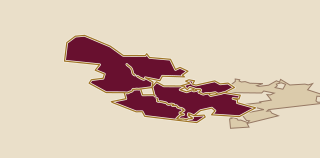
Cross the Dordogne from Bordeaux's Left Bank and the working grapes change. Libournais is led by Merlot and Cabernet Franc, with Cabernet Sauvignon in a smaller role. Clay, limestone, gravel and sand replace the long gravel corridor of the Médoc. The wines generally feel rounder at a younger age, but the area is too varied to collapse into one Right Bank style. The Dordogne is the cleanest first boundary on the map.
Merlot changes the shape
Merlot brings body and softness, while Cabernet Franc adds perfume and structure. Their balance shifts with the ground. Saint-Émilion runs from limestone plateau and slopes to gravel and sand; Pomerol is closely associated with clay; Fronsac and Canon-Fronsac occupy their own hills farther west. This is why two bottles carrying the wider Right Bank idea can still feel quite different.
Three famous names, then the satellites
Saint-Émilion is both a village and a broad appellation, with Saint-Émilion Grand Cru alongside it. Pomerol and Lalande-de-Pomerol form another pair. Fronsac and Canon-Fronsac sit closer to the Dordogne. Around Saint-Émilion, the satellite names Lussac, Puisseguin, Saint-Georges and Montagne keep the parent name on the label. The commune tells you more than the words Right Bank ever could.
A useful way in
Read the commune before the château
Begin with a Saint-Émilion satellite, Fronsac or Lalande-de-Pomerol to learn the Merlot and Cabernet Franc pattern without starting at the most famous estates. Then compare it with Saint-Émilion or Pomerol. The useful question is where the bottle comes from and which grape leads, not whether it carries the grandest name.
Elsewhere in Bordeaux
Continue through the region
- Bourg & Blaye22 producersBourg & Blaye is Bordeaux's Right Bank estuary country, centred on Merlot-led reds from Côtes de Bourg and Blaye Côtes de Bordeaux.
- Entre-Deux-Mers11 producersBetween the Garonne and Dordogne, Entre-Deux-Mers is known mainly for crisp dry whites and broadly priced Bordeaux wines.
- Graves & Pessac-Léognan20 producersSouth of Bordeaux, Graves and Pessac-Léognan place structured reds and ageworthy dry whites on the same gravel ground.
- Médoc59 producersMédoc is Bordeaux's Cabernet-led Left Bank peninsula, a gravel corridor containing Margaux, Saint-Julien, Pauillac, Saint-Estèphe and four wider appellations.
- Sauternes & Sweet Wines19 producersMorning mist, afternoon sun and noble rot turn Sémillon into Bordeaux's most concentrated sweet wines around Sauternes and Barsac.
A considered starting point
Producers in Libournais
- Château AngélusSaint Émilion château making Merlot and Cabernet Franc wines, from Château Angélus to the younger Tempo d’Angélus.
- Château AusoneSaint-Émilion estate named for Ausonius, with limestone minerality and a Grand Vin raised in new French oak.
- Château FigeacSaint-Émilion estate on three gravel knolls, making red wines from Cabernet Franc, Cabernet Sauvignon and Merlot.
- Château LafleurChâteau Lafleur comes from Bordeaux, France.
- Château de SalesNorthwest Pomerol château with a two wine range and smooth, refined wines marked by silky tannins.
Browse 28 more
- Château Beau-Séjour BécotA Saint-Émilion Grand Cru Classé estate on the Saint-Martin de Mazerat limestone plateau, shaped by Merlot-led vineyards and deep cellar history.
- Château Belair-MonangeChâteau Belair-Monange is a Saint-Émilion estate with medieval origins and vineyard evidence reaching back to the Roman era.
- Château Bellefont-BelcierSaint Émilion château on the Côte Pavie slopes, making a Merlot led red from three Bordeaux grape varieties.
- Château Certan de MayPomerol estate with one block of vines, deep clay and gravel, and a Merlot led red.
- Chateau DalemChâteau Dalem is a Saillans estate with vines planted in 1610, a Merlot-led Fronsac red, limestone and clay parcels, and a cellar rebuilt in 2019.
- Château de ParenchèreEastern Bordeaux estate with 60 hectares under vine, clay limestone soils, organic certification, and red, white, and rosé wines.
- Château FaizeauMontagne-Saint-Émilion château with Merlot led reds, an old vine Merlot grand vin, and Château Chants de Faizeau as second wine.
- Château Grand Corbin-DespagneA Saint-Émilion château with Merlot led red wine, 53 parcels and French oak élevage.
- Château La CabanneMerlot led Pomerol red wine from blue clay soils, aged in French oak.
- Château La ConfessionSaint-Émilion Grand Cru red from Merlot, Cabernet Franc and Cabernet Sauvignon, aged in 100% new French oak.
- Château La Croix Saint-VincentFamily owned Pomerol producer making Château La Croix Saint-Vincent, an organic Merlot and Cabernet Franc second wine.
- Château La CroizilleSaint Émilion Grand Cru Classé château with 4.5 hectares, low yields, drastic selection, and high Cabernet Sauvignon content.
- Château LaroqueSaint-Emilion Grand Cru Classé château with a 61 hectare holding, a Grand Vin, and Les Tours de Laroque as its secondary wine.
- Château LassègueSaint Émilion château making red Bordeaux from clay, chalk and limestone, with stainless steel fermentation and French oak ageing.
- Chateau MélinLibourne estate producing Saint-Émilion Grand Cru, including the Merlot Cuvée ReVinTho aged in French oak.
- Chateau Pierrail EarlDemonchaux family Bordeaux estate with red, white and rosé wines, named releases and a related Château Arnaud property.
- Chateau Puy-RazacSaint-Émilion family estate with a 7 hectare sandy clay block and red wines from Merlot and Cabernet Franc.
- Château Rocheyron SARL.Château Rocheyron is a Saint-Émilion estate co managed by Silvio Denz and Peter Sisseck, with Merlot, Cabernet Franc and concrete vat vinification.
- Château Tour BaladozChâteau Tour Baladoz crafts Saint-Émilion red wines through hand harvesting, mixed-vat fermentation and extended French oak aging.
- Château Vieux MougnacFounded in 1870 by Félix Milhard, Château Vieux Mougnac remains with the same family and makes Bordeaux Supérieur reds from Merlot and Cabernet varieties, with natural yeast, concrete maturation, and extended château ageing.
- Clos CantenacClos Cantenac presents a 2023 Saint-Émilion Grand Cru red wine noted by several leading critics.
- Établissements Jean-Pierre MoueixBordeaux Right Bank merchant and producer with holdings in Pomerol and Saint-Émilion.
- SCEA du Château de LussacA Merlot-led Lussac-Saint-Émilion estate where clay and clay-limestone soils meet French-oak-aged red with blackberry fruit, fresh acidity and ripe tannin.
- ThunevinSaint-Émilion reds from the Thunevin family, led by Château Valandraud: clay-and-limestone fruit, close vineyard work and long ageing in new French oak.
- Vignoble HermouetChâteau Roc Meynard spans Bordeaux Supérieur, Clairet and two white bottlings under Vignoble Hermouet.
- VIGNOBLES DAVID BEAULIEUVIGNOBLES DAVID BEAULIEU comes from Bordeaux, France.
- Vignobles Jean-Pierre EstagerChâteau La Cabanne is the Estager family’s Pomerol estate, producing dark-fruited reds shaped by clay-rich soils and extended French-oak ageing.
- Vignobles ThomasA family-run Listrac-Médoc estate where Petit Verdot-rich Château Reverdi sits beside the Merlot-led, barrel-aged Château l’Ermitage.