
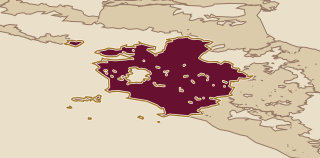
Montalcino's wine zone follows the historic borders of its municipality, between the Ombrone, Asso and Orcia rivers. The climate is dry Mediterranean, with occasional continental conditions, and most rain falls in spring and late autumn. Soils vary across a hill formed in different geological ages. Higher vineyards tend to give more aromatic, softer wines than sites on the valley floor. Brunello di Montalcino became DOCG in 1980, the first Italian wine to receive that status. Its profile includes black and red cherry, layered fruit, black licorice and spice.
Elsewhere in Toscana
Continue through the region
- Bolgheri & Etruscan Coast18 producersBolgheri & Etruscan Coast has modern plantings of Cabernet Sauvignon, Cabernet Franc, Merlot, Petit Verdot, Syrah and Sangiovese. Its soils include sandy clay loam, deep alkaline ground, fine gravel and fossil shells.
- Carmignano & Prato HillsNo producers listed yetCarmignano & Prato Hills includes Carmignano, Barco Reale di Carmignano and Vin Santo di Carmignano. Grand Duke Cosimo III formally defined Carmignano in 1716.
- Chianti Hills67 producersChianti Hills includes Chianti and Chianti Classico among its listed appellations. Chianti Classico names historic central Chianti, rather than the whole Chianti appellation.
- Elba IslandNo producers listed yetElba Island is a wine area within Toscana, with Elba and Elba Aleatico Passito as its listed appellations.
- Lucca, Apuane & Northern Coast4 producersLucca, Apuane & Northern Coast is a wine area within Toscana, with Colline Lucchesi, Montecarlo and Candia dei Colli Apuani among its listed appellations.
- Maremma Grosseto6 producersMaremma Grosseto is a wine area within Toscana. Its listed appellations include Maremma toscana, Morellino di Scansano, Monteregio di Massa Marittima and Bianco di Pitigliano.
- Montepulciano & Valdichiana13 producersVino Nobile di Montepulciano is one of the listed appellations in Montepulciano & Valdichiana. It uses 70-100% Sangiovese, locally called Prugnolo Gentile, and its Pieve designation received provisional publication in 2024.
- San Gimignano & Sienese Hills2 producersSan Gimignano & Sienese Hills includes Vernaccia di San Gimignano, a dry white with freshness, savouriness, medium body and persistence.
Producer profiles
Producers in Montalcino
- Antonio Mastrojanni Societa Agricola Societa SempliceA Brunello di Montalcino estate in Castelnuovo dell'Abate, farming 14.4 hectares of Sangiovese on lacustrine clay and sand soils since 1975, now owned by Francesco Illy of the coffee family and moving toward biodynamic viticulture.
- ArgianoBrunello di Montalcino estate on a 350-metre calcareous marl plateau in the southwestern corner of Montalcino, farming 42 hectares of Sangiovese with a traditional large-cask ageing program rebuilt under new ownership from 2013.
- Azienda Agricola Cordella MaddalenaMaddalena Cordella farms Sangiovese Grosso on the heavy sandy clays of Torrenieri, in the northeastern sector of Brunello di Montalcino, where Crete Senesi soils produce a rounder, riper house style than the limestone zones closer to town.
- Azienda Agricola MartocciaAzienda Agricola Martoccia brings Montalcino’s long-recognized Martoccia vineyard name to a focused collection of Rosso and Brunello wines.
- Biondi-SantiThe Tuscany estate that named and bottled Brunello di Montalcino for the first time in 1888, farming 33 hectares northeast of Montalcino on five vineyard plots.
- Castello BanfiMariani family estate in Montalcino, producing Brunello di Montalcino and the Merlot-Cabernet Super Tuscan Excelsus from a 2,830-hectare contiguous holding on the southwestern slopes of the hill.
Browse 16 more
- Castello RomitorioA Brunello di Montalcino estate founded in 1984 by Transavanguardia painter Sandro Chia, who bought a ruined medieval castle on the northwestern Montalcino ridge and planted 100% Sangiovese.
- Castello TricerchiCastello Tricerchi is a Montalcino estate with northern slopes, Sangiovese Grosso, castle cellars, and Brunello and Rosso di Montalcino.
- Ciacci Piccolomini d'AragonaA Montalcino Brunello estate run by the Bianchini family, who inherited it from the last countess of the Ciacci Piccolomini d'Aragona line in 1984.
- Col d'OrciaCol d'Orcia is a 540-hectare estate at the southwestern edge of Brunello di Montalcino, farming organically since 2010 and aging its wines in large Slavonian and Allier oak casks.
- Conti CostantiConti Costanti farms twelve hectares of galestro hillside above Montalcino and makes Brunello from a family whose Sangiovese was exhibited under that name in Siena in 1870.
- GiodoCarlo Ferrini's personal estate in Montalcino: six hectares, eight hand-selected Sangiovese clones, and a 2019 Brunello that garnered significant critical attention.
- La PalazzettaLa Palazzetta is a Fanti-family estate on the southeastern slope of Montalcino, farming about 20 organically certified hectares of Sangiovese on limestone-rich soil at 365 metres near the Abbey of Sant'Antimo.
- Le RagnaieMontalcino estate farming three geographically separate corners of the hill, bottling each parcel under its own label to show what the same Sangiovese says in different soils and elevations.
- Pian delle Querci Societa AgricolaFamily estate in Montalcino making Brunello di Montalcino DOCG from clay-soil Sangiovese, fermented without added yeast in steel and aged three years in new large Slavonian oak.
- Pieve Santa RestitutaThe Gaja family's Brunello di Montalcino estate, purchased in 1994 as their first move outside the Langhe in 135 years.
- Podere BrizioPodere Brizio is a Montalcino estate focused on Sangiovese, with southwest-facing vineyards, olive groves and a soil-conscious approach.
- San PoloBrunello estate on the warm southeastern face of Montalcino, farming galestro soils with organic practices and an underground cellar designed to cool by natural insulation.
- Societa Agricola Podere le RipiMontalcino estate with biodynamic vineyards in Castelnuovo dell'Abate and Camigliano, making Brunello di Montalcino, Rosso di Montalcino and Sant'Antimo.
- Tenuta Buon TempoOrganic Brunello di Montalcino estate at Castelnuovo dell'Abate, built from a 2012 purchase and a bare cellar; 14 hectares of Sangiovese Grosso aged three years in large Slavonian-oak casks.
- Tenuta di ArgianoA founding member of the Consorzio del Brunello since 1967, Argiano farms 60 hectares of Sangiovese on the southwestern slope of Montalcino at 350 metres.
- Tenute Silvio NardiTwo-estate Brunello producer on opposite slopes of the Montalcino hill, farming Sangiovese Grosso across 49 registered hectares and assembling its flagship from 20 separately vinified parcels.