
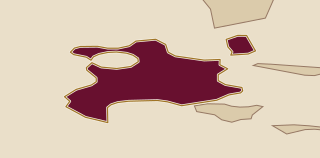
Stellenbosch sits within South Africa's Coastal Region, close enough to the ocean for cooling air to matter but warm enough to ripen Cabernet Sauvignon fully. Warm days, cooler nights and well-drained soils give the district a strong red-wine identity. The landscape changes from valley floors to mountain slopes, so the name covers more than one exposure or mesoclimate. The district rewards comparisons between slope, valley and producer.
Cabernet gives the district its spine
Cabernet Sauvignon is the clearest starting point. It appears alone and in blends, bringing black fruit, tobacco, pencil lead, smoke and tannin that can support ageing. Merlot, Cabernet Franc and other red varieties broaden the blend, while Chenin Blanc and other whites show that Stellenbosch is not solely a Cabernet district. The common thread is structure rather than one fixed recipe.
A deep producer bench
The producer directory shows how many routes the district offers. Kanonkop and Meerlust are closely tied to the red-wine conversation; Jordan works from hillside vineyards; Ken Forrester makes Chenin Blanc part of the picture; Raats focuses attention on Chenin Blanc and Cabernet Franc; Reyneke farms biodynamically. Together they make a more useful introduction than a single house style could.
A useful way in
Begin with Cabernet, then widen out
Start with a Stellenbosch Cabernet Sauvignon or a Cabernet-led red blend. It gives you the district's firmest and most recognisable line. Follow it with Chenin Blanc or Cabernet Franc from a named producer and the range of the place becomes clearer without losing the connection to its warm days, cool nights and mountain-influenced sites.
Elsewhere in Coastal Region
Continue through the region
- Cape Town5 producersCape Town incorporates Constantia, Hout Bay, Durbanville and Philadelphia. Cool, maritime Constantia is associated with elegant Sauvignon Blanc and historic sweet wines.
- Darling2 producersAtlantic influence in Darling's Groenekloof ward is closely associated with cool-climate Sauvignon Blanc.
- Franschhoek26 producersFranschhoek's sheltered mountain valley produces Cabernet Sauvignon and Syrah with dark fruit, spice and soft tannin.
- Paarl8 producersWarmer Paarl is associated with fuller, bolder wines. Its name refers to granite that glistens after rain.
- Swartland8 producersWarm, dry Swartland is associated with concentrated Syrah and Chenin Blanc. Its modern wine movement drew attention to independent, site-focused wines.
- Tulbagh6 producersMountain-sheltered, inland Tulbagh is associated with fresh, high-acid Cap Classique shaped by sharp night-time cooling.
- Wellington3 producersWellington's inland mountain and alluvial sites bring cooler nights and varied mesoclimates, supporting a range of wine styles.
A considered starting point
Producers in Stellenbosch
- Kanonkop EstateA Stellenbosch estate on the Simonsberg slopes, built around Pinotage and a Bordeaux blend named for the politician who shaped the farm from 1929.
- Meerlust EstateWestern Cape estate-grown reds shaped by False Bay breezes, granite-and-clay soils, and a long Myburgh family history.
- Jordan WineryA 164-hectare Stellenbosch estate run since 1993 by Gary and Kathy Jordan, a geologist and economist who spent two years in international cellars before building their own.
- Ken Forrester WinesStellenbosch estate on the Helderberg slopes built around Chenin Blanc, with FMC as the flagship and old-vine Piekenierskloof fruit for the natural wine tier.
- Raats Family WinesA Polkadraai Hills producer founded in 2000 around Stellenbosch Chenin Blanc and Cabernet Franc.
- Reyneke WineryStellenbosch wines from the historic Uitzicht farm, where companion-planted vines and low-intervention cellar work shape Syrah, Cabernet and Chenin.
Browse 46 more
- Alto EstateStellenbosch red-wine estate making Cabernet-led blends from steep granite slopes since 1922.
- BLANKbottle WineryPieter Walser sources from 66 growers across the Western Cape and produces 40 to 50 wines each year from spontaneous fermentations in concrete egg, amphora, and oak, with every label hand-drawn by Walser himself.
- Botanica WinesStellenbosch producer at Protea Heights, with a Bordeaux blend, estate fruit in Big Flower, Cape site wines and regenerative farming.
- Catherine Marshall WinesWestern Cape producer of Pinot Noir, Chenin Blanc, Riesling and Sauvignon Blanc, sourcing mostly from cool climate areas and separating fruit by soil type.
- Cave de PongraczCave de Pongracz makes Méthode Cap Classique sparkling wines, including Desiderius Brut 2018 and Pongrácz Rosé.
- Damascene WineryJean Smit's place-argument project, sourcing Syrah and Chenin Blanc from contrasting soils across Stellenbosch, Swartland, and the Ceres Plateau, with cellar work kept deliberately minimal so the character of each site comes through.
- Die BergkelderDie Bergkelder is a Stellenbosch mountain cellar linked to Fleur du Cap, with underground maturation and a Pinotage wine.
- Escapade WinerySouth African venture sourcing Western Cape grapes for a Sémillon Sauvignon Blanc blend fermented in steel and French oak.
- Glenelly EstateA former Pichon Lalande owner built a gravity-flow winery on Simonsberg's lower slopes in Stellenbosch, farming without acidification and using wild yeast fermentation.
- Hartenberg EstateStellenbosch estate that bottled South Africa's first commercial Shiraz in 1968, farming nine soil types across Bottelary Hills.
- Kaapzicht EstateA Bottelary Hills estate built on two of South Africa's oldest surviving vineyards: Chenin Blanc planted in 1947 and Pinotage from 1959, with two Decanter World Wine Awards to its name.
- Kaapzicht Wine EstateSouth African family estate with old bush vine Chenin Blanc, Steytler Pinotage, and a Pinotage Cabernet Sauvignon blend.
- Kleine ZalzeKleine Zalze is a Cape Winelands winery near Stellenbosch, with 120 hectares of estate vines and wines from Chenin Blanc, Cabernet Sauvignon and Pinotage.
- Lanzerac Wine EstateStellenbosch estate in the Jonkershoek Valley, with Pinotage red wines and a Pinotage Rosé.
- Lievland VineyardsStellenbosch estate with restored vineyards, dry rosé from Syrah and Mourvèdre, and a berry led red blend.
- LokaiaFranschhoek project pairing Semillon, Chardonnay and Cabernet Franc with early picking, skin contact and terracotta amphorae.
- Longridge WineryLongridge Winery farms the Helderberg in Stellenbosch wine country with biodynamic methods, an ecological farm system and cellar work led by Jasper Raats.
- Miles Mossop WinesSmall-volume Western Cape wines built from selected vineyards, with Miles Mossop directing both viticulture and winemaking.
- Mooiplaas Wine EstateFamily-run Stellenbosch estate on steep Bottelary Hills slopes, pairing unwooded Chenin Blanc with a Merlot–Cabernet Franc red shaped by oak and tannin.
- Mulderbosch VineyardsStellenbosch Kloof producer with Sauvignon Blanc, Chenin Blanc, Cabernet Franc, rosé and red wines.
- Mullineux & Leeu Family WinesSwartland and Franschhoek partnership making Syrah, Chenin Blanc and Straw Wine with indigenous yeasts and little new wood.
- MuratieA Knorhoek Valley estate north of Stellenbosch, Muratie turns its history into named bottles, from the Cabernet-led Ansela van de Caab to George Paul Canitz Pinot Noir.
- Naudé WinesStellenbosch label sourcing Western Cape fruit for old vine Colombard, Cinsault and heritage blends made with minimal intervention.
- Neethlingshof EstateA Stellenbosch estate between the Bottelary Hills and Papegaaiberg Mountain, with False Bay winds helping white grapes retain acidity.
- Post House EstateA Stellenbosch-linked estate near False Bay, where a 1996 Shiraz experiment grew into Merry Widow.
- Post House VineyardsPost House Vineyards farms the Helderberg foothills, with Merlot reds and barrel fermented Chenin Blanc between Somerset West and Stellenbosch.
- Rall WinesDonovan Rall’s Western Cape label, built from Swartland and Stellenbosch fruit selected for soil and vine age.
- Richard Kershaw WinesAn Elgin virtual winery matching grape clones to selected sites, then turning Chardonnay, Syrah and Pinot Noir into cool-climate wines with clear structural differences.
- Rust en Vrede EstateA Helderberg red-wine estate south of Stellenbosch, centred on Cabernet Sauvignon, Syrah and Merlot.
- Saam Mountain VineyardsA South African collective of forty growers, SAAM brings dry-farmed fruit from Paarl to Durbanville into one cellar at Perdeberg.
- Sakkie Mouton Family WinesSmall-production West Coast whites from Vredendal, shaped by decomposed sandstone, cool coastal air, old vineyards and bright saline acidity.
- Shannon VineyardsSmall Elgin estate wines from mist-cooled hillside vineyards, spanning Sauvignon Blanc-Semillon blends, barrel-aged Semillon, Pinot Noir and clone-led Merlot.
- Simonsig EstateA Malan family estate in northern Stellenbosch, known for Kaapse Vonkel and a range spanning old-vine Chenin Blanc, Pinotage and Cabernet Sauvignon.
- Spier Wine FarmA historic Stellenbosch farm beside the Eerste River, Spier separates older-vine Chenin Blanc, coastal Chardonnay and Shiraz, and blended red wine into distinct bottle families.
- Spioenkop WinesCool-climate Elgin wines from Koen Roose, led by bone-dry Riesling and a range spanning Chenin Blanc, Pinotage and Sauvignon Blanc.
- Stark-Condé WinesFamily-run Jonkershoek Valley estate centred on Cabernet Sauvignon, with elevated single-vineyard bottlings and a hands-on cellar.
- Stellenbosch VineyardsA Stellenbosch producer based at Welmoed Farm, turning selected-grower fruit into a broad portfolio led here by a dark-fruited Shiraz–Pinotage red.
- Thistle & WeedTwo-person Western Cape producer bottling single-parcel wines under Cape weed names, with Chenin Blanc from a 1980 Stellenbosch vineyard.
- Trizanne Signature WinesTrizanne Barnard sources Sauvignon Blanc and Sémillon from windswept Elim on the Cape South Coast and Syrah from the hot, dry Swartland, split across two ranges built on the contrast between those two climates.
- Uva MiraMountain vineyard estate on the Helderberg slopes in Stellenbosch, farming at 260 to 620 metres above sea level.
- Vriesenhof VineyardsA Stellenbosch farm in Paradyskloof Valley, Vriesenhof brings Chardonnay, Pinot Noir and Pinotage into a range shaped by Atlantic breezes, hand-harvested fruit and barrel work.
- Warwick EstateA Simonsberg estate where Cabernet Sauvignon anchors dark, structured red blends, balanced by a citrus-and-stone-fruit Chardonnay.
- Warwick Wine EstateSimonsberg Cabernet Sauvignon with a family-made origin story: Warwick’s first wine was the 1984 La Femme Bleu, released after the Ratcliffes had spent twenty years on the farm.
- Waterford Wine EstateA Stellenbosch estate on the Helderberg slopes, Waterford works 60 hectares of vine within a 120-hectare property and explores an unusually broad cast of red grapes.
- Wolf & Woman WinesJolandie Fouché’s Swartland-focused project turns old-vine fruit into textured Chenin Blanc, fresh-framed Pinotage and peppery Syrah.
- Zevenwacht Wine EstateFamily-owned Stellenbosch estate working Ribbokrant slopes and Banhoek fruit across a broad range of Western Cape whites and reds.