
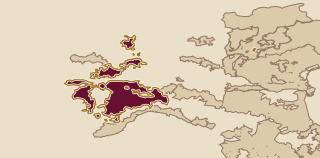
Monferrato and Asti spread across rolling hills east of the Langhe. Barbera occupies many of the sunniest slopes, but it shares the area with Moscato, Grignolino, Ruchè, Brachetto, Dolcetto and Freisa. Part of this vineyard landscape belongs to the UNESCO site shared with Langhe and Roero, a reminder that Piemonte's famous hills continue well beyond Barolo and Barbaresco.
Red wine and bubbles share the hills
Barbera d'Asti and Nizza carry the area's red-wine centre of gravity. Asti and Moscato d'Asti turn Moscato Bianco into sparkling and gently sparkling wines, while Brachetto adds an aromatic red counterpart. The shift from dry red to fragrant fizz can happen within a short drive, which is why this part of Piemonte resists a single grape or style.
A label map with many local grapes
Look for Barbera d'Asti, Nizza and Barbera del Monferrato first. Ruchè di Castagnole Monferrato, Grignolino d'Asti and Grignolino del Monferrato Casalese preserve smaller red-grape names. Brachetto d'Acqui, Dolcetto d'Acqui and Dolcetto di Ovada pull the map toward Acqui and Ovada. The appellation usually tells you both the grape and the part of the hills it belongs to.
A useful way in
Begin with Barbera, then change register
Barbera d'Asti is the most direct first bottle: bright in acidity, modest in tannin and easy to place at the table. Follow it with Moscato d'Asti for the area's lighter, aromatic side, or Ruchè and Grignolino for reds that move away from Barbera's familiar shape.
Elsewhere in Piemonte
Continue through the region
- Alto Piemonte11 producersAlto Piemonte is cooler and higher, with Nebbiolo-based blends grown on volcanic and glacial soils. Its Nebbiolo tends toward redder fruit and less tannic structure than southern Piemonte examples.
- Canavese & Torinese7 producersCanavese & Torinese sits near the Alps, where altitude and morainic soils shape the wines. Canavese is associated with the Erbaluce and Carema DOCs, and Erbaluce is a historic Piemonte variety.
- Langhe149 producersLanghe is the Nebbiolo core of Piemonte, with Barolo and Barbaresco on calcareous marl hills. Barbera, Dolcetto, Arneis and Pelaverga are also classic local varieties.
- Roero9 producersAcross the Tanaro from the Langhe, Roero pairs softer Nebbiolo with Arneis. Roero Arneis must contain at least 95% Arneis and can show peach, pear, almond and floral notes.
A considered starting point
Producers in Monferrato & Asti
- Braida di Giacomo BolognaThe Piedmontese estate that transformed Barbera from a bulk carafe grape into a cellar-worthy single-vineyard wine, starting with one hillside in Rocchetta Tanaro in 1982.
- La SpinettaLa Spinetta is a Piedmont family estate that in 1977 produced the first single-vineyard Moscato d'Asti in Italy, and has since built one of the most awarded portfolios in the region across Moscato, Barbera, Barbaresco, and Barolo.
- MontalberaMonferrato estate that bet its mid-1980s expansion on Ruchè, the aromatic red variety that only reached DOCG in 2010.
- Giulio CocchiAromatized wine house in Asti, Piedmont.
- ScarpaOld Piedmontese house in Nizza Monferrato farming Barbera in the Monferrato hills and Nebbiolo into the Langhe for Barolo, known for long barrel aging and extended bottle rest before release.
Browse 29 more
- Angelini Wines & EstatesA Tuscany-rooted estate group uniting Val di Suga, Tenuta Trerose and San Leonino, with Sangiovese central to its listed wines.
- Azienda Agricola Angelini PaoloFourth-generation Monferrato family estate best known for Arbian, a Grignolino del Monferrato Casalese aged four years under the Monferace collective's extended protocol.
- Azienda Agricola Boggero-Bogge WineFamily farm estate in Vaglio Serra making Barbera d'Asti DOCG and Nizza DOCG from 8 hectares of vines.
- Azienda Agricola CrivelliFour-generation Piedmontese estate on the Montiò hill that farms Ruchè di Castagnole Monferrato and helped secure the grape's DOCG designation in 2010.
- Azienda Vitivinicola Gianni DogliaPiemonte family estate anchored to Moscato d'Asti DOCG, with two lees-differentiated cuvées and a full Monferrato red range.
- Cantina Sant EvasioThird-generation Monferrato estate in Nizza Monferrato farming 10 hectares of Barbera and Arneis, with the Nizza D.
- Cantina Sociale di CasorzoFarmer-owned cooperative in Casorzo, Monferrato, built around Malvasia Nera and its DOC appellation.
- Cantine VolpiFifth-generation Piedmontese family winery founded in 1914 in Tortona, producing organically certified wines anchored by Timorasso from its Cascina La Zerba estate in Volpedo.
- Cantine Volpi srlFive-generation Piedmontese producer founded in 1914 as the wine supply for a family osteria in Tortona, now exporting organic wines to 35 countries with Timorasso Derthona as its flagship white.
- Cascina CappelleSix-generation Piedmont family estate on fossil-bearing limestone at a hilltop sanctuary in Mongardino, making Barbera d'Asti, Monferrato Nebbiolo, Monferrato Dolcetto, and Grignolino d'Asti.
- Cascina La BarbatellaA five-hectare organic estate in Nizza Monferrato built around a parcel of Barbera vines planted in 1950.
- Cascina VignaCascina Vigna is a family-run Piedmont estate cultivating seven hectares and producing Barbera, Freisa and Nebbiolo wines.
- Chazalettes & Co.Turin vermouth house founded in 1876, revived from a century-old recipe book.
- Cossetti Clemente e Figli S.r.l.Family estate in Castelnuovo Belbo, centred on native Barbera and Moscato, with Moscato d'Asti from San Colombano.
- Dacasto DuilioFive-generation family estate in Agliano Terme farming 8 hectares across three Barbera tiers, a Burgundy-minded Chardonnay, and traditional-method Alta Langa sparkling wine.
- DezzaniCocconato-based Piemontese producer making Barbaresco and Barolo from Langhe Nebbiolo through cooperative partnerships with hundreds of grower families across Monferrato and Langhe.
- Guasti Clemente e FigliOld-vine Barbera estate in Nizza Monferrato, founded in 1946 by Clemente Guasti, who was among the first producers in the town to print vineyard origins on Barbera bottle labels.
- Marco BonfanteMarco Bonfante is a Piedmontese estate in Nizza Monferrato run by siblings Marco and Micaela, founded in 2000 after the family split when their father died.
- PerlinoPiedmont house founded in Asti in 1905, producing Charmat-method sparkling wines and a century-old botanical vermouth at industrial scale.
- Società Agricola MontalberaThe dominant estate in the Ruché di Castagnole Monferrato DOCG, farming more than 100 hectares in the Asti hills around a single aromatic red grape and three ascending tiers of complexity.
- Società Agricola Tenuta Santa Caterina S.R.L.An ancestral Monferrato estate revived from decades of abandonment, farming indigenous Grignolino and Barbera on the Colli Divini hills above Grazzano Badoglio, with 17-metre Infernotto cellars carved from local tuff.
- Tenuta Bricco San GiorgioSmall family estate in Vinchio, Monferrato, run by Davide Laiolo on six personally managed hectares.
- Tenuta La FiammengaA fourth-generation organic estate in Cioccaro di Penango making Barbera d'Asti with slow fermentation, prolonged skin contact, and more grip than the appellation typically delivers.
- Tenuta la MeridianaFive-generation Monferrato estate bottling Barbera d'Asti from plot-specific vineyards since 1890, named for the sundial that led villagers to its door.
- Tenuta La PergolaA fourth-generation Bodda family estate in Cisterna d'Asti, farming Nebbiolo, Barbera, Arneis, and Croatina at the geographic junction of three of Piemonte's most distinct hill systems, with SQNPI sustainable certification and wines across the Terre Alfieri DOCG.
- Tenuta MontemagnoTenuta Montemagno makes Monferrato wines from Timorasso, Sauvignon, Barbera and Syrah in Montemagno, Asti.
- Tenuta San MauroBianco family estate on a hill between Asti and Alba, making Barbaresco from 100% Nebbiolo and Alta Langa sparkling wines in Castagnole delle Lanze.
- Tenuta Santa CaterinaEighteenth-century Monferrato estate revived on organic principles, farming Nebbiolo and Piedmontese natives in UNESCO-listed infernotto cellars seventeen metres underground.
- VinoryPiemonte DOCG wines from Barolo and Barbaresco to Roero Arneis, Nizza and Barbera d'Asti, with named vineyard crus and hand harvested Nebbiolo.